

If you’re anything like me, just about all of your friends—in fact, most of the people you encounter in your day—wear some type of fitness tracker. In the more progressively health-minded community, Oura Rings and Whoop bands abound. Athletes sport their Garmin and Coros and Polar watches. Maybe your sister has a Fitbit or your dad wears a Jawbone. And it seems like every other person has an Apple watch, which they use to record their steps, sleep, exercise heart rate, or heart rate variability.
Yep, we’ve become a society that’s increasingly interested in using technology to track our movement and guide our training decisions.
How about you? Do you check your Whoop Recovery or your Garmin Training Readiness score before deciding whether to bang out the hard workout you planned? Do you feel like a loser on days you fail to hit 10,000 steps according to your Fitbit? And here’s the really interesting question: SHOULD you?
It’s a question I ask myself frequently: whether fitness trackers help or hinder us, whether the information they provide really helps us be healthier, and what are the downsides. Let’s explore.
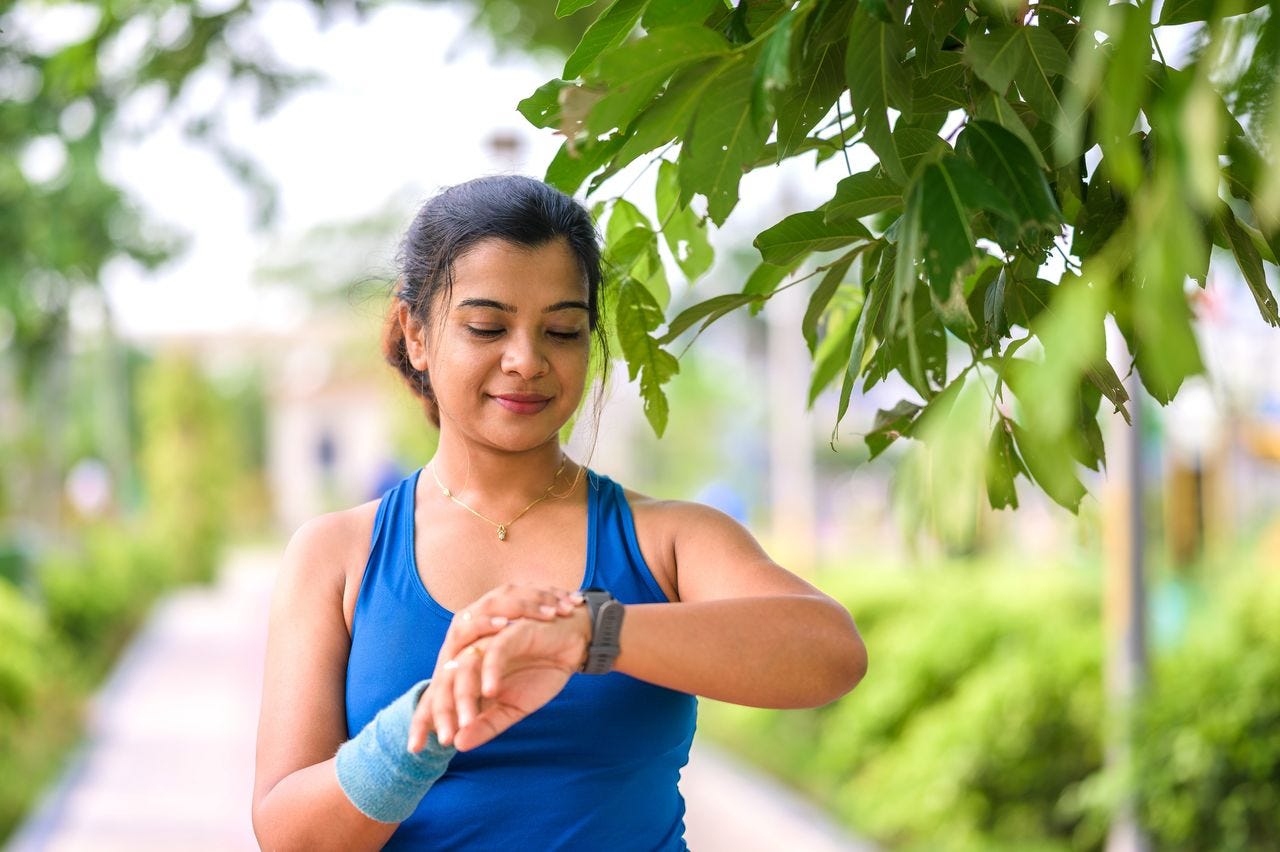
Are Fitness Trackers Accurate?
It depends on what technology you’re talking about and what you’re trying to measure. There are dozens, maybe hundreds, of different pedometers, heart rate monitors, and other tracking devices to track your activity and biometrics. They include
Watches and bracelets/wristbands
Chest straps
Clothing with built-in tools
Devices you wear in your ear
Fingertip devices
Patches or monitors that adhere to the skin (forehead, arm)
And this doesn't even include things like designated sleep trackers, continuous glucose monitors, ketone meters, and the like. Plus new technologies are constantly emerging. Accuracy data is often hard to come by, especially for trackers that aren’t the big name brands, but here are some findings we can glean from the research:
A 2022 paper reviewed the current state of fitness wearable technology and concluded the various wrist-worn devices are somewhat accurate for measuring step count but lack sufficient precision when it comes to oxygen saturation or VO2.1
For monitoring heart rate, chest straps are still superior to fitness watches. Apple watches perform decently well during exercise, and the big-name players all seem to do well at rest.2-4
Generally speaking, HRV is more accurate when measured over longer time periods (overnight) and at rest, compared to shorter (e.g., 5-minute) time periods and during exercise.5 A study comparing overnight HRV readings from the Whoop band, Oura ring, a Garmin watch, Polar watch, Apple Watch, and Somfit forehead patch found that Whoop was the most consistent with electrocardiogram and Garmin (Forerunner 245) was the worst.([6])
Study after study finds that fitness trackers across the board are bad at reporting energy expenditure.7-9
So it's a mixed bag, but that's not a huge hit against wearables.
The fact is, unless you’re a high-level athlete or a scientific researcher, you probably don’t need your fitness tracker to be as accurate as the gold-standard, medical-grade technology that costs thousands of dollars.
Good enough is good enough—and today’s tech is mostly good enough for folks who are just trying to be more mindful of their activity level and improve their fitness. Raw step count and resting HR are the most important features of today’s fitness trackers anyway, as they allow you to track
Daily activity. Are you moving frequently at a slow pace? Walking is the foundation of good physical, mental, and psychological health. It’s fundamental to our species—we’re walkers. Step count, along with movement reminders if your device offers them, are all you really need to get a sense of how active or sedentary you are any given day.
Heart rate zone. If you’re at all interested in becoming a fat-burning beast, spending a lot of time in the aerobic heart rate zone (below a heart rate of 180 minus age) will get you there. Heart rate monitoring can help you figure out what it looks and feels like.
Like what you’re reading? Share it so others can find it.
The Million-dollar Question: Do Fitness Trackers Encourage More Activity and Make You Healthier?
The biggest reason to wear a tracker, as I see it, is to discourage sedentary behavior and get people moving. So do they?
They can… IF you use them consistently. A 2022 review of studies encompassing 163,992 individuals of all ages and health statuses concluded that fitness tracking does increase activity to the tune of about 40 extra minutes per day of walking, or 1,800 additional steps. That’s not nothing. Those researchers also failed to find any evidence that this led to meaningful health changes aside from very modest weight loss of around 1 kg (half a pound). However, they noted that most studies were fairly short in duration, not long enough to see massive health gains. Another review found that for weight loss, it took at least 12 weeks to see significant results.10 In other words, you can't use it for a few weeks and expect magic. Just like everything else.
Really, though, it doesn't matter if it works for other people. It doesn’t matter if most people quit using them after a matter of months, as some studies suggest is the case.
At the end of the day, if tracking your activity does motivate you, then it works. For you.
“For you” is the only relevant qualifier.
What Are the Downsides?
One potential downside that has little to do with the accuracy of the technology or the technology itself: we silly humans exalt numbers over feelings, objectivity over subjectivity. You wake up feeling great, motivated to hit the track for your planned sprint workout—except your watch tells you that you slept poorly or gives you a subpar recovery score. So, you skip your workout and feel sluggish all day. Self-fulfilling prophecy? Perhaps.
Maybe I’m old school, but I’m far more interested in fine-tuning my intuition than relying on technology to tell me how I feel.
Of course, objective data can be useful. Your Oura Ring detects a rise in body temperature portending an oncoming illness, allowing you to scale back your workouts so as not to tax your immune system. Your Garmin tells you your recovery score is in the red, so you take a much-needed rest day after a week of hard training. That’s fine. Sometimes you need these checks and balances to offset a “go hard or go home” training mentality. But your tracker isn’t the be all and end all.
Ideally, you'd use the data it provides in conjunction with, not in place of, your subjective assessments and wisdom gained from experience.
I’ve also noticed how once you start quantifying your physical activity, any activity you don’t track loses value. If you forget your wearable, you lose your steps. If, God forbid, your Strava followers won’t see the workout you did today, you may be less likely to do it—especially if you’re only moving to pad your stats. Health-seeking behaviors only become second-nature when we can derive intrinsic value from their pursuit. Trackers can help you derive some of that value. You pay closer attention to your steps per day, and aim for more, when you’re getting real-time feedback, your friends are getting notifications when you hit your goals, and your wrist is buzzing with excitement over your 10,000th step. That's rewarding. Keep doing it, and it becomes a habit.
Make sure you’re also stepping back and looking at the big picture. How do you feel physically and mentally in weeks when you get more activity? How does moving more feed into other health-promoting choices, like eating better or getting sleep? What other benefits are you deriving aside from the immediate dopamine hit of closing your exercise ring?

Best Practices for Using a Fitness Tracker
Wear it on the same spot. Clip your pedometer to your lapel, your hip, your wrist, or your ankle as long as you wear it there every time. Make sure your watch is tight enough to engage the sensor. The more consistent you are, the more accurate the device will be.
Be accurate when entering your personal data. To give you accurate data, the tracker needs to know your real height and weight. If your weight changes, update it.
Calibrate your step length. Some wearables allow you to calibrate your true step length when you start using the device. Doing so will improve the accuracy of distance tracking. S
top moving when taking your heart rate. Many consumer wrist-wearables have a harder time accurately tracking heart rate when you’re in motion. To get an accurate reading, stop exercising and rest for 5 to 10 seconds before checking your HR.
Focus on trends, not absolute numbers. If what the device says about last night’s sleep corresponds to how you feel about last night’s sleep, it has value. If it conflicts—if you feel great despite getting poor marks on your tracker—perhaps not so much. A single night’s dip in HRV is nothing to worry about. A week or two of low (for you) numbers is worth digging into.
Most importantly, use your fitness tracker to enhance and inform your intuition, not replace it. This wasn’t intended to be a review of all the available fitness trackers. It was a quick review of the evidence for and against along with my personal take on the technology. Let’s also acknowledge that technology evolves rapidly, and these companies are constantly working to improve their algorithms. There’s a good chance that they will become increasingly accurate in coming years—but the downsides I laid out will remain the same.
I’d love to hear about your experiences with wearables down below. What worked? What didn’t? What did you gain from wearing a fitness tracker? What have you lost?
Thanks for reading, everyone.
References
https://www.ncbi.nlm.nih.gov/pmc/articles/PMC9022022/ ↩
https://pubmed.ncbi.nlm.nih.gov/36803578/ ↩
https://www.ncbi.nlm.nih.gov/pmc/articles/PMC6732081/ ↩
https://www.ncbi.nlm.nih.gov/pmc/articles/PMC9412437/ ↩
https://pubmed.ncbi.nlm.nih.gov/29668452/ ↩
https://www.ncbi.nlm.nih.gov/pmc/articles/PMC9412437/ ↩
https://www.ncbi.nlm.nih.gov/pmc/articles/PMC7509623/ ↩
https://www.ncbi.nlm.nih.gov/pmc/articles/PMC7240439/ ↩
https://www.ncbi.nlm.nih.gov/pmc/articles/PMC8817215/ ↩
https://www.ncbi.nlm.nih.gov/pmc/articles/PMC10116995/ ↩
Mark’s Daily Apple is still under construction. My team and I are actively working to repost the archives. Check back regularly to find posts that are new to you and revisit old favorites. Looking for a specific post? Let us know here.
You can help more people find us by spreading the word:

* This blog reflects my personal views and opinions and isn’t intended as medical advice, but I hope it will be informative and inspiring as you pursue a healthy, fulfilling life.