

For a great many people, work stinks. Actually, let’s put that a little differently: For a great many people, indoor work stinks.
We’ve discussed the “nature deficit disorder” running rampant throughout contemporary society before. Kids are more likely to control video game characters than to get out and explore the real world themselves. Adults routinely go entire days without stopping to smell a flower, caress a blade of grass, or even see a shred of foliage.
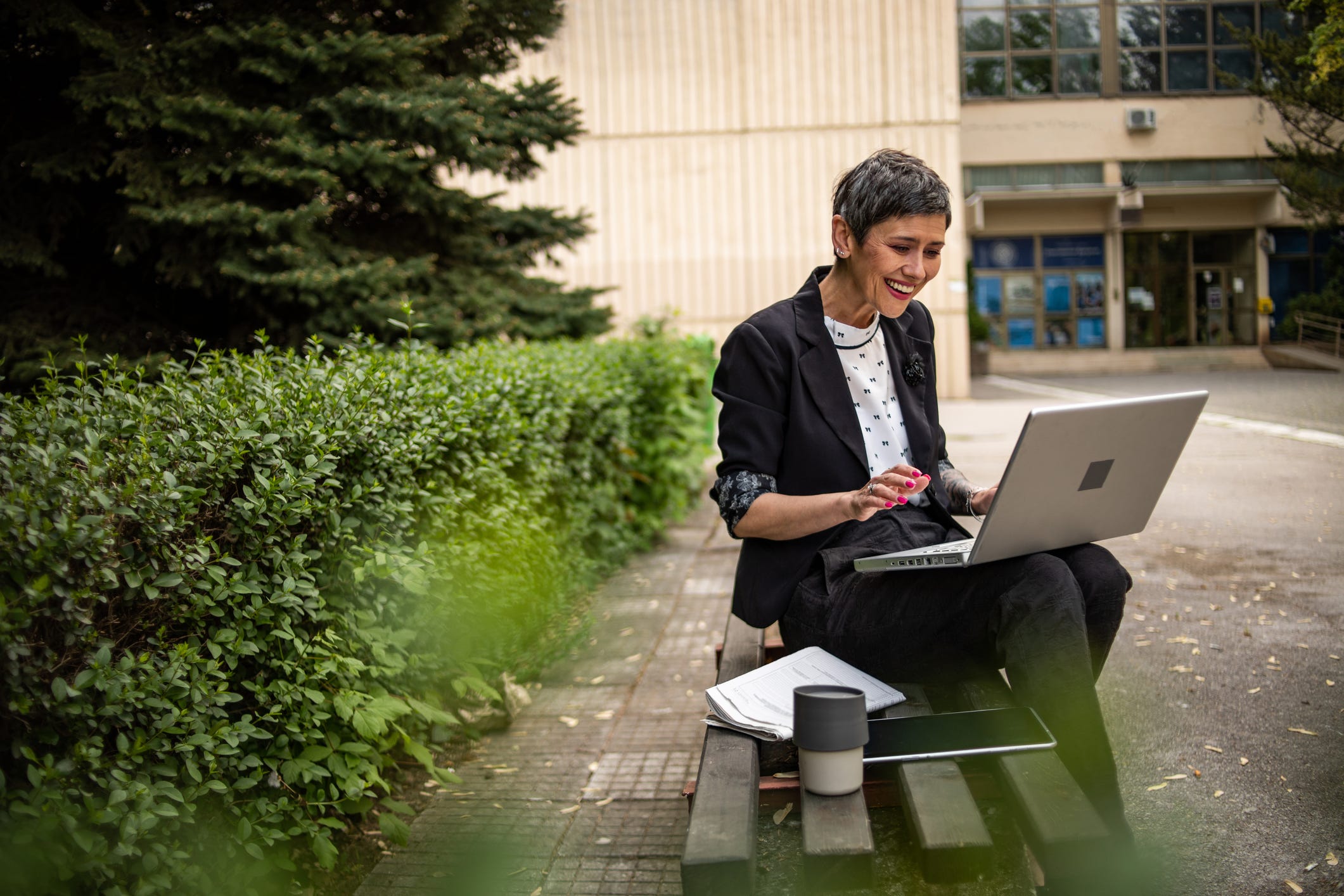
For many adults, our jobs are largely to blame for keeping us inside. What if it didn’t have to be like that? What if you could work outside, commune with nature as you typed, feel the grass underfoot as you brainstorm, and hear not the drone of the overhead lighting but rather the chirp of birds or the rustle of wind in the trees?
First, though, you have to convince your boss—or yourself, if you’re self-employed—that you’ll be a healthier, happier, more productive worker if you’re not sitting indoors all day at a desk. Unfortunately, there’s very little direct research dealing with the benefits of working outdoors versus indoors, but we can make predictions based on the considerable benefits of being outside in general.
Let’s look at some science-backed benefits of doing more of your work outdoors.
Humans NEED Nature
This isn’t just about finding the best backdrop for your next Instagram post. Humans have an innate need to be in nature. Being in and around leaves and trees and sand and bugs and dirt and desert and all the rest is the natural state of the animal known as human.
A lack of nature seems to cause physical and mental health problems, while spending time outdoors improves physical and mental health.
Consider the incredible benefits that occur once people go forest bathing or hiking, when they commune with animals, or plant a small garden. Even indoors, we’re better off when we incorporate biophilic design elements—think natural wood furniture, water features, and houseplants. And yet, we’ve walled ourselves in and convinced ourselves that we do our best work in offices and cubicles.
I think we couldn’t be more wrong.
4 Science-backed Reasons to Spend More Working Hours Outdoors
There’s every reason to believe that we’d be better off spending more of our working hours outside. Consider the following essential health benefits of nature exposure:
1. Less stress
I think the physical work environment—the indoor lighting, the walls boxing you in, the uniform sameness of it all—is a major cause of work-related stress, above and beyond the pressure to perform the duties of your job. But you probably don’t need to give up your office and do all your work from a hammock to counteract that. A study from the University of Michigan found that spending time “in nature”—as defined by the participants—led to significant reductions in cortisol and alpha-amylase, both biomarkers of stress.1 Notably, exposures lasting just 20 to 30 minutes produced the bulk of the benefits. Another study looking specifically at the effects of taking outdoor work breaks found that even 10 minutes might suffice.2
2. Better physical health.
The myriad physical health benefits of time in nature are well-documented, including
Lower blood pressure3
Higher HRV4-5
Reduced inflammation6
Enhanced immune system function7
It’s easy to see how these could lead to fewer sick days, increased productivity, even more motivation to show up and work hard. Some of this might be chalked up to the aforementioned stress reduction, but there are also direct effects related to fresh air, sunlight, and exposure to elements in nature like phytoncides—VOCs that act on the autonomic nervous system.8
3. More creative problem solving.
When I’m stuck on a problem, whether it’s something job-related or something in my personal life, nothing helps more than hopping on my stand-up paddle board. It’s something about the water, the sunshine, and the physical exertion. Disconnecting from devices probably doesn’t hurt either.
I’m not alone here. In a series of interviews with workers, researchers found that people felt better able to relate to one another and collaborate in an outdoor environment.9 Tossing off the constraints of the conference room freed them up to let their creative juices flow.
4. Better attention to detail and memory.
For all intents and purposes, humans have two types of attention: voluntary, or active, attention and involuntary, or passive, attention. If voluntary attention is like an intense workout, involuntary attention is the low-intensity active recovery. We need both. Psychologists believe that nature exposure is a way to foster involuntary attention—of recharging your attentional bank, so to speak. In one study, for example, taking a 50-minute walk around a campus greenspace significantly boosted participants’ performance on a test of attention and memory.10 Even just looking at photos of nature seems to boost attention.11
Making the Leap to Working Outdoors
I’m not suggesting that we raze all the office buildings and turn them into parks, although I’d consider that proposal. But surely there is a happy medium where we make a conscious effort to work in nature.
Take calls from a park bench.
Stroll around a pond during your next meeting with a coworker, using an app to dictate meeting notes as you go.
Eat lunch outside.
What if you set up a standing desk under a gazebo so that you were sheltered from the elements and you could format that slide presentation while a gentle rain fell around you?
The Covid pandemic showed us that old notions of office work were antiquated and unnecessarily stifling. But while corporate overlords may (begrudgingly) accept that working from home is a viable option, there’s still this idea that time spent in natural environments is wasteful. I’m not buying it. For hundreds of thousands of years, people have been making tools, setting traps, building homes, butchering beasts, and discovering math, science, physics, and astronomy, all while living in or near nature. Even if you lived in a city or village, nature was waiting outside the walls. Still we worked, and worked well.
Why not now? Why not today?
References
https://pubmed.ncbi.nlm.nih.gov/31019479/ ↩
https://psycnet.apa.org/record/2017-55582-001 ↩
https://pubmed.ncbi.nlm.nih.gov/22948092/ ↩
https://www.ncbi.nlm.nih.gov/pmc/articles/PMC6562165/ ↩
https://pubmed.ncbi.nlm.nih.gov/19568835/ ↩
https://www.ncbi.nlm.nih.gov/pmc/articles/PMC8872601/ ↩
https://pubmed.ncbi.nlm.nih.gov/17903349/ ↩
https://www.ncbi.nlm.nih.gov/pmc/articles/PMC4548093/↩
https://www.ncbi.nlm.nih.gov/pmc/articles/PMC10488277/ ↩
https://pubmed.ncbi.nlm.nih.gov/19121124/ ↩
https://pmc.ncbi.nlm.nih.gov/articles/PMC4929355/pdf/nihms797471.pdf ↩
Mark’s Daily Apple is still under construction. My team and I are actively working to repost the archives. Check back regularly to find posts that are new to you and revisit old favorites. Looking for a specific post? Let us know here.
You can help more people find us by spreading the word:
* This blog reflects my personal views and opinions and isn’t intended as medical advice, but I hope it will be informative and inspiring as you pursue a healthy, fulfilling life.