Though it's an important aspect of the Primal Blueprint, the concept of play might be the foundational concept people struggle with the most. So many have forgotten how to play that they need a little help.
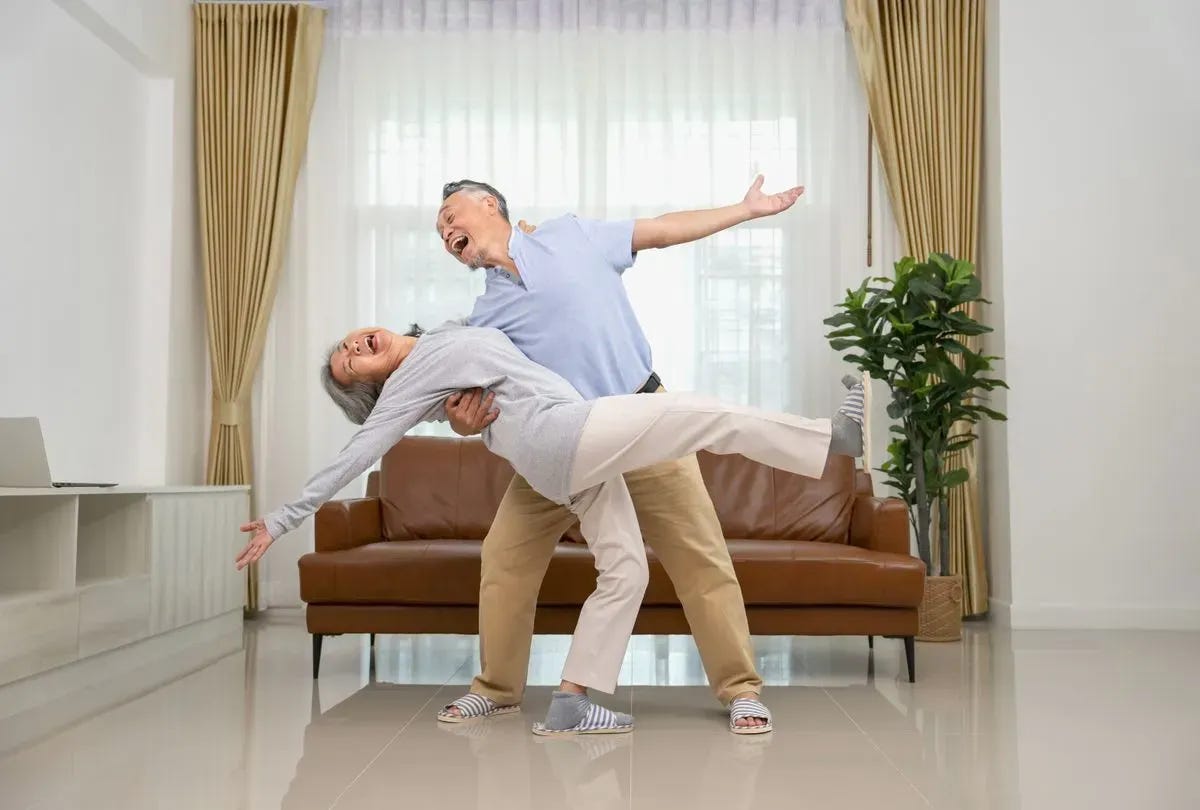
One of the best ways to play is to dance.
Until now, almost everything I’ve suggested as Primal play activities has had an overt physical fitness slant. Pickup basketball, Ultimate Frisbee, hikes, walks with the spouse, random play with dogs/kids/wilderness—these are all great, enjoyable activities, but they are workouts. Enjoyable forms of workouts, but workouts. Most people see a guy on a hike and think “exercise.”
Dancing is different. It’s physical, sure, but people generally don’t think of it as exercise. For almost every other physical pursuit, you put on “workout” clothes. Active wear. Clothing designed to withstand sweat. When you go dancing, you wear normal clothes or dress up. Clothing you’d rather not sweat while wearing. Clothing designed to make you look good. That’s not working out, but it is playing.
Why You Should Dance
Open to all.
There’s an idea in gaming that the best games are those that are easy to learn but hard to master. That’s dancing. It has a low barrier of entry—anyone can move to the beat—but if you want to get really good, you have to put in the work. Though not everyone can be a professional dancer, anyone can enjoy dancing.
Dancing explores the ranges of human movement.
Dance can be described as an exposition of human movement patterns; dancers explore the full range of human movements through three-dimensional space by leaping, contorting, falling, twisting, rotating, and spinning.
Dance is serious exercise.
Studies have shown that ballroom dancers typically dance at 80% of their max oxygen consumption, making it a legitimate form of exercise with many of the same physiological effects as traditional workouts. Dancing can improve cardiovascular health, increase stamina, strengthen muscles, and enhance flexibility. It’s a full-body workout that can be as gentle or as intense as you make it—endlessly adaptable.
Dance improves quality of life.
Moreover, dancing improves quality of life and fosters social connections, especially in populations that often suffer from isolation, like senior citizens. It reduces the incidence of dementia better than other leisure activities. And if you’re good enough, dancing can make you pretty damn attractive – talk about an evolutionary advantage.
Dance reduces depression.
In a recent meta-analysis of “alternative” exercise-based treatments for depression, dancing was the most effective, beating out other forms of exercise (which were already quite effective in their own right). This makes sense to me, because dancing is a kind of distilled happiness. Even if you don’t feel like dancing at first, if you force yourself to do it, you start having fun and feeling happy.
Dancing takes courage.
For some people, dancing is a frightening prospect. It takes guts to let yourself go, I mean really go, and do so with a smile on your face. Dancing renders the dancer completely vulnerable to outside criticism and prying eyes, but mostly to his or her own thoughts about what’s expected of a normal adult. Unless the alcohol is flowing, the lights are dimmed, and someone’s daughter is getting married, we’re not supposed to be dancing like wild men and women. We’re supposed to be composed and rational, and it simply isn’t “rational” to move your body to the sound coming out of speakers or instruments. But that is of course why we should be dancing.
Dance is universal.
Look at basically every traditional culture and you’ll find dance, along with music. In fact, the two are never really separated. You dance to music, after all. And since music is present in every culture, it’s a safe bet that Homo sapiens were banging on drums or singing chants since at least 50,000 years ago, which is roughly when the widespread dispersal of man out of Africa occurred. Some archaeologists even suggest dance has been around for over 1.5 million years, perhaps manifesting as a literal “mating dance” between potential partners looking for the right mate. Anyone who’s ever been to a gathering has seen this phenomenon in action—nothing really changes, huh?
Like this post? Share it so others can find it.
Even if dancing was useless and purely frivolous—that is, it conferred no concrete physiological benefits—it would still be worth doing because frivolity is part of what makes us human. We do things for the hell of it. We’ll sing nonsensical songs, make strange noises when we’re alone, twiddle our thumbs, play with our hair, think of distant jokes and laugh all over again. Do we need a reason? No. We just do it to amuse ourselves and occupy our minds.
Dancing should serve the same purpose in our lives. Like other forms of play, it can reduce stress, get us moving, help us spend quality time with loved ones and friends, and improve our coordination, mobility, and flexibility. If you’re learning a particularly complex set of steps or moves, dancing requires concentration and memorization. If you’re dancing with a partner, your brain has to anticipate the other’s movements and respond accordingly. This all works out to exercise for your brain and your body.
Now, I’m not suggesting that you have to dance. Just think of dance as a potential tool in your bag of tricks. Take your wife or husband to salsa lessons. Turn off the TV and blast some music one night, and just let loose. Dance with your kids in the kitchen. Gather some friends and do the bonfire/drum circle thing at the beach or in the woods somewhere. Pass around a bottle of wine, if you have to, and dance. It might even be enough to just bob your head when a favorite song comes on, or dance in the car at a stoplight. You may look silly, but who cares? You’ve got to get over that stuff, especially when it stands in the way of you truly enjoying life and all it has to offer. Recall the last person you saw rocking out behind the wheel—did you laugh at and pity him, or were you slightly envious of his obvious joy? Exactly.
Dance is many things, simple being foremost among all other characteristics. It doesn’t have to be deep or overly technical. Just dance for fun.
What do you think about dance? Does it have a playful place in the Primal lifestyle?
Mark’s Daily Apple is still under construction. My team and I are actively working to repost the archives. Check back regularly to find posts that are new to you and revisit old favorites. Looking for a specific post? Let us know here.
You can help more people find us by spreading the word: