

I’d venture to say that most, if not all, of us have experienced music’s emotional impact. Music has the power to turn a bad mood around, help us unwind from stress, and resurface happy memories, transporting us to a place of warm nostalgia. After a long day, a good playlist can make commute traffic a little more bearable. Sitting through a long dentist appointment isn’t quite so anxiety-provoking with your favorite tunes playing through headphones.
So it may feel a bit unnecessary to ask why music is important. Is it not self-evident? Music appears to strike some deeply embedded Primal chord. Archeological evidence shows that our ancient ancestors enjoyed music and made instruments in their free time. The oldest instrument ever recovered dates back approximately 60,000 years,1 but humans likely sang and used unmodified natural objects to make music long before then. It’s little surprise that music can touch us on such an elemental level. Still, I’m always interested to see how modern research unpacks and explains these intuitively human experiences.
Today, let’s explore some of the science-backed health benefits of music.
The Benefits of Music
On a broad level, people enjoy music for a variety of reasons. There’s the emotional impact I already mentioned. Music can evoke strong positive or negative feelings based not only on your personal relationship to the song but even the key in which it’s written. Even a few bars of a song can make you feel happy or morose, inspire awe or dread.
There’s also the social aspect. Listening to music alone in your car is one thing, but attending a performance with other people heightens the experience exponentially, whether it’s seeing your favorite band in a huge arena, watching a group of performers in a park, or attending a religious service. Making music with other people takes it to a whole other level. I can’t think of anything that bonds strangers together more quickly than a shared musical experience.
But what I’m interested in today is how music affects physical and mental health—and I’m not just talking about how the perfect jam can inspire you to give a little extra effort at the gym (though that doesn’t hurt). The following are just some of the ways that music can make you healthier:
Reduces stress, both subjective assessments (how people say they feel) and physiological markers such as cortisol and heart rate2
Improves sleep in both adults3 and children
Helps alleviate pain, of both the acute variety, such as that experienced by cancer or surgical patients, burn patients, or during childbirth,4-7 and the chronic variety, as in fibromyalgia (it also improves mobility in fibromyalgia patients)8
Enhances immune system function, as evidenced by favorable hormonal and neurotransmitter responses to music, along with an increase in antibodies and anti-inflammatory agents.9
By virtue of these wide-ranging benefits, you can imagine how music might be useful as an adjunct treatment for all manner of ailments. I’m not saying it’s going to replace chemotherapy for cancer or anything, but it’s the very definition of “can’t hurt, might help.” Based on the research I’ve looked at, I’d even say “can’t hurt, likely to help.”
Liking this post? Share it so others can find it.
How to Harness the Power of Music in Your Life
This one’s easy: Surround yourself with music. Make it more immersive by singing along. Dance. Play an instrument. Better yet, learn a new instrument. It’s one of the best things you can do for healthy brain aging according to experts, and the best way I’ve found to achieve flow. A friend described it to me once as totally letting go of himself in a swirl of sound. The body takes over, I guess, with instinct leading when technical artistry fades into the background.
Listen to music from different points throughout your life. And also listen to new stuff—even if it just sounds like noise. Use it as a way to connect with your kids and grandkids. Attend live music events. Whether it’s a full orchestra or a single street musician, it’s an experience beyond the best sound system. My wife and I attended an amazing vocal performance a few years back. The ensemble finished an amazing piece so dramatic and moving, you could hear a pin drop and feel an electricity hanging in the air while the audience caught its breath before the applause.
What happens to the body, to the brain in these transcendental moments? What happens when they’re a regular part of one’s life? One thing is for sure: they fill us long after the music has stopped.
Or try music therapy
If listening to and playing music isn’t enough, you could seek out a music therapist to administer a dose of “music medicine.” Just like with other therapy modalities, there are lots of ways to practice and receive music therapy. You might, with your therapist, listen to music or write lyrics as a way to release pent-up emotional baggage. Your therapist might use music to assist with guided meditations or relaxation exercises. They might teach you how to use chanting, drumming, or moving your body as a way to connect mind and body or release stress.
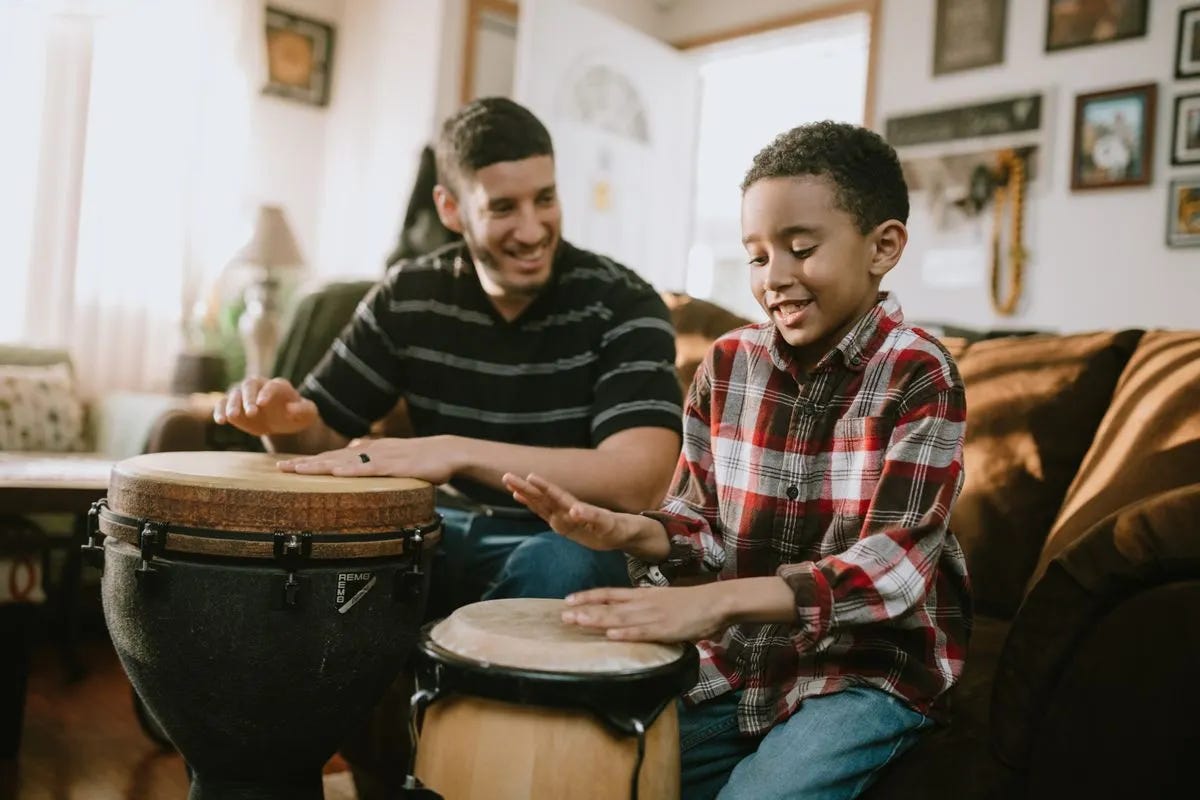
Of course, it doesn’t have to be that formal. You can just grab a couple hand drums and zone out next time you need a mental break. I bet it will help.
Thanks for reading today, and let me know your thoughts. What’s your history with music? How has it affected your life or your health?
References
https://www.nms.si/en/collections/highlights/343-Neanderthal-flute ↩
https://pubmed.ncbi.nlm.nih.gov/31167611/ ↩
https://pubmed.ncbi.nlm.nih.gov/33864907/ ↩
https://www.ncbi.nlm.nih.gov/pmc/articles/PMC6175460/ ↩
https://pubmed.ncbi.nlm.nih.gov/26277246/ ↩
https://pubmed.ncbi.nlm.nih.gov/34906387/ ↩
https://pubmed.ncbi.nlm.nih.gov/31951943/ ↩
https://www.ncbi.nlm.nih.gov/pmc/articles/PMC3920463/ ↩
https://www.ncbi.nlm.nih.gov/pmc/articles/PMC8566759/ ↩
Mark’s Daily Apple is still under construction. My team and I are actively working to repost the archives. Check back regularly to find posts that are new to you and revisit old favorites. Looking for a specific post? Let us know here.
You can help more people find us by spreading the word:
And make sure you’re subscribed!
* This blog reflects my personal views and opinions and isn’t intended as medical advice, but I hope it will be informative and inspiring as you pursue a healthy, fulfilling life.