

Let me get this out of the way: Treadmill running is better than sitting on the couch. If it’s your only option—or even just the way you prefer to exercise—then by all means use the treadmill. The best exercise is the one you’ll do.
But there are limitations, risks, and biomechanical changes that occur when treadmill running. It’s not the same as running outside, and there’s evidence to suggest it might be worse in some respects.
So let’s explore the potential problems associated with treadmill running.
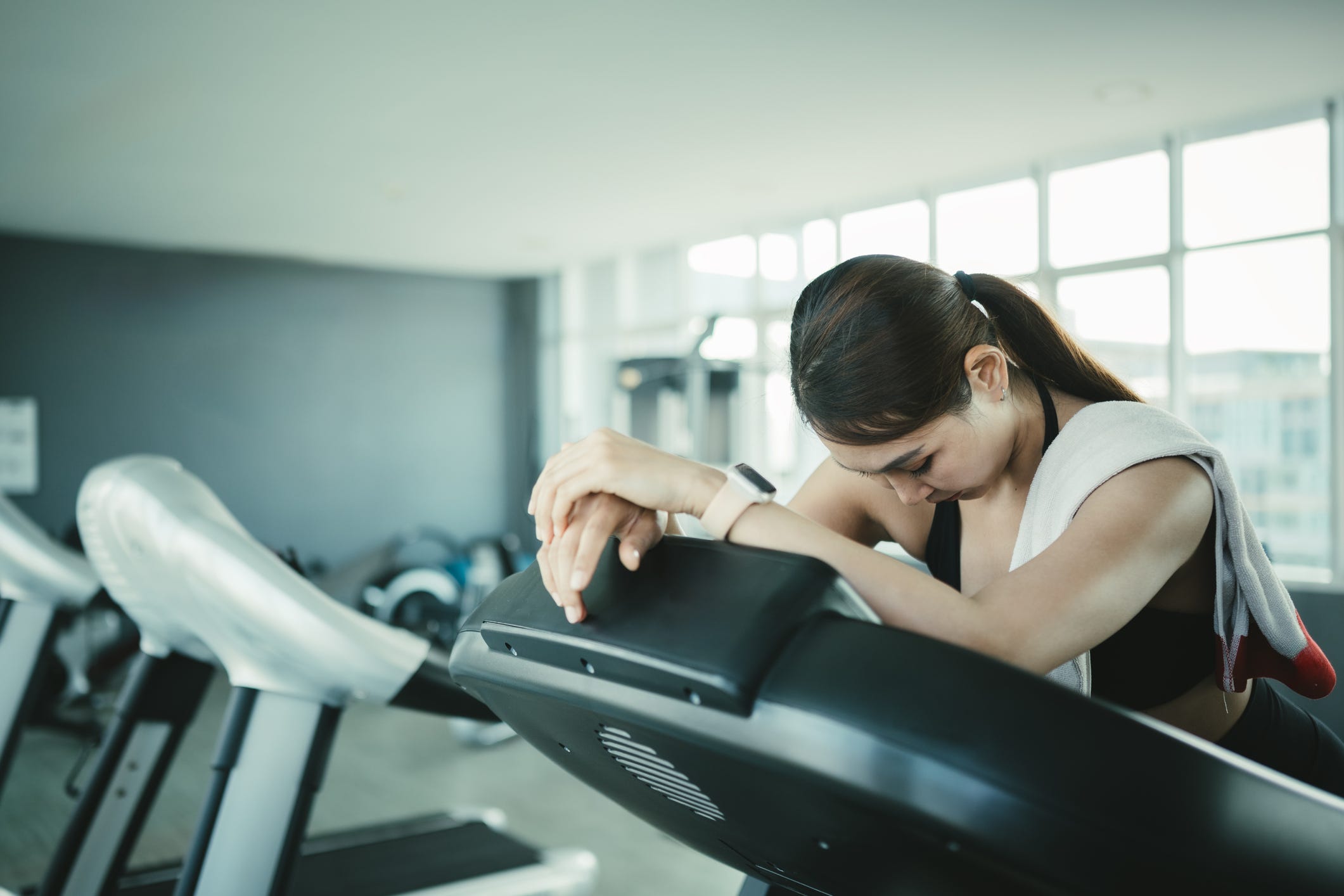
A Case for Running Outdoors
1. Running outside is more enjoyable.
A 2004 study out of Duke University found that treadmill runners reported higher RPE (rates of perceived exertion) despite running more slowly. They also enjoyed themselves less and experienced less satisfaction than runners doing their thing outside.
If an exercise is so boring that it becomes work and you don’t feel like you accomplished much after doing it, you are less likely to do that exercise.
2. Treadmills are flat and linear and unchanging. The outside world is not.
Running outside across natural ground is characterized by thousands of subtle biomechanical reactions to every pebble, half-buried root, slight dip, furrow, bump, and elevation or incline change—and our bodies adapt to this nonlinear environment by becoming stronger and more balanced.
On a treadmill, every step you run is the same as the last one. Your foot lands in exactly the same place with exactly the same cushioning. Your joints receive the same stresses. This is a recipe for repetitive strain injuries.
3. Treadmills change the biomechanics of your run.
One study found that treadmill runners showed significantly greater peak eversion (rolling inward), eversion velocity, tibial internal rotation, and tibial internal rotation velocity than overground runners. Treadmill runners have also been shown to take longer strides, altering their gaits to spend more time in the air and allow more of the treadmill to pass under.
Another 2013 study found major differences between accelerating on the treadmill and accelerating on the ground. On the ground, the runner accelerates and modifies his or her biomechanics to accommodate the acceleration. On the treadmill, the belt accelerates, and “virtually no kinesiological adaptations to an accelerating belt are observed.”
Still, is this a problem? Plenty of people use treadmills everyday seemingly without any major issues.
Even though a human body can technically perform many novel movements without apparent harm, be wary of altered movement patterns that persist. Consider the carpal tunnel from using a mouse and keyboard that develops over the course of many years. Consider the weakened glutes, tight calves, and tight hip flexors office workers often have. You can sit in a chair for a day, week, or even months on end and feel completely fine. It’s the sitting for years and decades that get to and prevent us from being able to squat comfortably or engage our glutes.
I’m similarly suspicious of treadmill running, particularly with the subtle but significant kinematic changes observed. And because treadmill running is higher intensity than clicking a mouse or sitting at your desk, the negative effects — if they exist — likely accumulate much faster.
4. Treadmills don’t engage the posterior chain as much as running outside.
Runners typically generate the majority of their power with their posterior chains: the glutes and the hamstrings. It’s the hip extension, powered by the glutes and hamstrings, that propels the runner across the terrain.
Since treadmill running cuts way back on peak hip extension the already sorely underdeveloped (from sitting and office work and generally sedentary living) posterior chain receives even less attention. Why engage the glute to bring your leg back and your body forward if the treadmill belt does it for you?
5. Treadmills are “easier” but harder.
Running at the same speed on the treadmill requires less energy expenditure than running at the same speed outside—yet treadmill running feels harder, so we think we’re working harder than we actually are.
Less work and fewer results despite greater perceived effort? No thanks.
Bonus reason: running outside checks multiple boxes.
When you run outside, you’re getting:
Natural light for circadian entrainment.
Sunlight for vitamin D and nitric oxide.
Green space exposure for stress reduction, cortisol inhibition, and mood boosting.
Where you need to go. You can actually use running outdoors as a mode of transportation.
I get that treadmills are more convenient for some people. My point is that running (or walking, or whatever you’d do on a treadmill) outside is far more efficient in every possible manner than running on a treadmill. If you have the choice, choose outdoors.
What If the Treadmill Is Your Best Option?
Sometimes, though, running indoors makes the most sense due to weather, safety concerns, or other practical considerations. Maybe you just like it. In that case, there are some things you can do to mitigate any downsides.
Set an incline.
This makes treadmill running a little more similar to road running by engaging more posterior chain. And one study found that treadmill running with a 1% grade effectively recreated the energetic cost of flat ground running.
Try self-powered manual treadmills.
These are decent substitutes for ground running. They're a little more posterior chain intensive than normal running, since you're actually moving the mill.
Take breaks from the treadmill.
Don't run exclusively on the machine. Get outside for some runs, and be sure to throw in posterior chain strength work (Romanian deadlifts, kettlebell swings, hill sprints).
Listen to music, podcasts and/or audio books.
On the few occasions that I go for a "run" these days, I always choose an interesting locale. The beach, the mountains, a new city (when traveling). Running in interesting environments becomes its own reward, and I never find I need a pair of headphones whisking me away to another place. The setting is its own entertainment.
But a treadmill is stationary, usually in a gym. There's not much going on worth watching, hearing, or smelling, and this is a big reason why treadmill runners rate their experiences as less satisfying and pleasurable; there's neither intrinsic nor extrinsic value. So strap on a set of headphones (or earbuds), subscribe to a podcast or two, and give yourself more satisfaction and enjoyment each time you run.
Sprint.
Some research finds that the kinematic differences between treadmill running and overground running, while substantial, disappear at speeds higher than 6 m/s (13.4 mph). Sprinting just makes everything better, doesn't it? Just don’t do it more than once per week.
Again: I don't mean to bash treadmills. They can certainly be helpful, and many successful athletes use them in their training. But very few of the top people are using treadmills exclusively. For any endurance athlete, the majority of the work is done on the road.
Enough from me. Let's hear from you folks. Do you use the treadmill? Does any of today's post ring true to your experience? What differences do you notice between treadmill and road running?
Thanks for reading, everyone. Take care.
Mark’s Daily Apple is still under construction. My team and I are actively working to repost the archives. Check back regularly to find posts that are new to you and revisit old favorites. Looking for a specific post? Let us know here.
You can help more people find us by spreading the word:

* This blog reflects my personal views and opinions and isn’t intended as medical advice, but I hope it will be informative and inspiring as you pursue a healthy, fulfilling life.