4 Aug

How to Succeed with the Primal Blueprint

So you’ve decided to join the challenge. You’ve created your own Primal Challenge Journal and have publicly stated your goals for the next month. Now what? First things first. You have to know the basics. If you’re new to the Primal Blueprint the following article will be like gold to you. Revisit it again and again until you’ve committed the concepts to memory. The graphs and charts are visual representations of the principles that are at the core of the Primal health philosophy and give you a taste of what it is in my new book, The Primal Blueprint.

You’ve defined the “what”. If your goal is to lose weight, build muscle, increase energy or just generally look and feel healthier these graphics explain the basics of the “how”.

The Primal Blueprint Carbohydrate Curve

What’ll It Be? The “Sweet Spot” or the “Danger Zone”?

Picture2 How to Succeed with the Primal Blueprint

Carbohydrate intake is often the decisive factor in weight loss success and prevention of widespread health problems like Metabolic Syndrome, obesity and type 2 diabetes. These average daily intake levels assume that you are also getting sufficient protein and healthy fats, and are doing some amount of Primal exercise. The ranges in each zone account for individual metabolic differences.
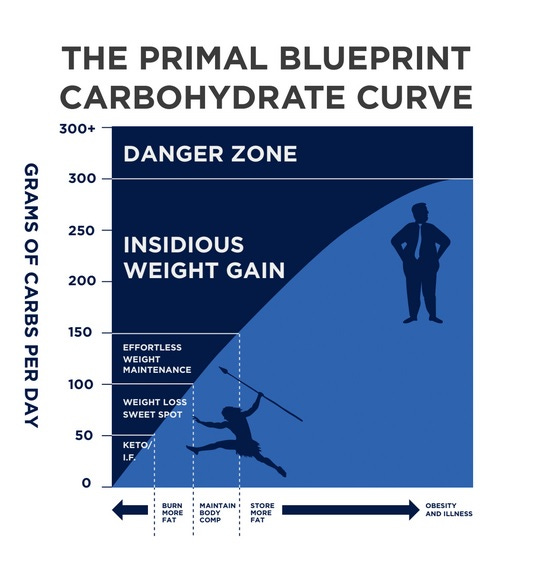
  • 0-50 grams per day: Ketosis and I.F. (Intermittent Fasting) zone. Excellent catalyst for rapid fat loss through I.F. Not recommended for prolonged periods (except in medically supervised programs for obese or Type 2 diabetics) due to unnecessary deprivation of plant foods.
  • 50-100 grams per day: Sweet Spot for Weight Loss. Steadily drop excess body fat by minimizing insulin production. Enables 1-2 pounds per week of fat loss with satisfying, minimally restrictive meals.
  • 100-150 grams per day: Primal Maintenance zone. Once you’ve arrived at your goal or ideal body composition, you can maintain it quite easily here while enjoying abundant vegetables, fruits and other Primal foods.
  • 150-300 grams a day: Insidious Weight Gain zone. Most health conscious eaters and unsuccessful dieters end up here, due to frequent intake of sugar and grain products (breads, pastas, cereals, rice, potatoes – even whole grains). Despite trying to “do the right thing” (minimize fat, cut calories), people can still gain an average of 1.5 pounds of fat every year for decades.
  • 300+ grams a day: Danger Zone of average American diet. All but the most extreme exercisers will tend to produce excessive insulin and store excessive fat over the years at this intake level. Increases risk for obesity, Metabolic Syndrome and type 2 diabetes.

The Primal Blueprint Food Pyramid

For effortless weight loss, vibrant health, and maximum longevity

Picture3 How to Succeed with the Primal Blueprint

General Guidelines: 80% of body composition success is determined by diet. Limit processed carb intake (hence, insulin production), and obtain sufficient protein and fat to fuel and rebuild.

  • Protein: Average .7 – 1 gram per pound of lean body mass/day – depending on activity levels (more at times is fine).
  • Carbs: 50-100 grams/day (or less) = accelerated fat loss. 100-150 grams/day = effortless weight maintenance. Heavy exercisers can increase carb intake as needed to replace glycogen stores.
  • Fat: Enjoy freely but sensibly for balance of caloric needs and high dietary satisfaction levels.
  • Avoid Poisonous Things: Conventional Wisdom’s dietary guidelines promote fat storage, type 2 diabetes, inflammation and obesity!
  • Eliminate: Sugary foods and beverages, grains (wheat, corn, rice, pasta, breads, cereals, etc.), legumes (soy and other beans), trans and partially hydrogenated fats, high-risk conventional meat and produce, and excess PUFA’s (instead, increase omega-3 oils).
  • Modern Adjustments: Some modern foods that Grok didn’t eat can still be included in a healthy diet
  • Moderation: Certain high glycemic fruit, coffee, high-fat dairy products, starchy tuber vegetables, and wild rice.
  • Supplements: Multivitamin/mineral formula, probiotics, omega-3 fish oil and protein powder.
  • Herbs, spices and extracts: Offer many health benefits and enhance enjoyment of meals.
  • Sensible indulgences: Dark chocolate, moderate alcohol, high-fat treats.

The Primal Blueprint Fitness Pyramid

For functional, diverse athletic ability, and a lean, proportioned physique

Picture4 How to Succeed with the Primal Blueprint

Exercising according to the three Primal Blueprint laws will optimize gene expression and promote Primal Fitness.

  • Law #3: Move Frequently at a Slow Pace strengthens the cardiovascular and immune systems, promotes efficient fat metabolism and gives you a strong base to handle more intense workouts.
  • Law: #4: Lift Heavy Things stimulates lean muscle development, improves organ reserve, accelerates fat loss, and increases energy.
  • Law #5: Sprint Once in a While stimulates the production of HGH and testosterone, which help improve overall fitness and delay the aging process – without the burnout risk of excessive prolonged workouts.

The Conventional Wisdom approach to fitness is clearly not working! Stress is excessive, weight loss goals are compromised, and many are misguided to pursue narrow fitness goals that are unhealthy.

  • Avoid Chronic Cardio (frequent medium-to-high intensity sustained workouts)
  • Avoid Chronic Strength Training (frequent and/or prolonged sub-maximal lifting sessions ending in exhaustion)
  • Avoid Regimented Schedules (instead, allow for spontaneous, intuitive variation in type, difficulty and frequency of workouts)

All this and much more can be found in my new book, The Primal Blueprint. Order a copy today and start getting Primal!

Subscribe to Mark’s Daily Apple feeds

You want comments? We got comments:

Imagine you’re George Clooney. Take a moment to admire your grooming and wit. Okay, now imagine someone walks up to you and asks, “What’s your name?” You say, “I’m George Clooney.” Or maybe you say, “I’m the Clooninator!” You don’t say “I’m George of George Clooney Sells Movies Blog” and you certainly don’t say, “I’m Clooney Weight Loss Plan”. So while spam is technically meat, it ain’t anywhere near Primal. Please nickname yourself something your friends would call you.

  1. Nice all encompassing post Mark. I love the carbohydrate curve. It puts everything in perspective and it works! More importantly it works in a sustainable way that is completely enjoyable. I’ve lost 8 pounds effortlessly in one month.

    Best,

    Ted

    Ted wrote on August 4th, 2009
  2. I’m sure this will vary from person to person, but what is the maximum intake of carbs before you trigger a spike in insulin? I thought I read you don’t want to eat more than 30g in one sitting but want to see what the consensus is.

    Steve wrote on August 4th, 2009
  3. Thanks for the pyramids! I’m a visual person, so this puts things into perfect perspective. I need to add more vegetables to my diet, pronto.

    Min wrote on August 4th, 2009
  4. As much as I love PB 200-300 grams of carbs a day won’t always produce “insidious weight gain”:

    http://www.youtube.com/user/mikeroussell#play/uploads/30/lqJSSMhXKj0

    And Tom Venuto:
    “If fat loss is your number one goal and you want to achieve it the healthy way
    without losing muscle or energy, then you can’t go wrong with 50-55% carbohydrates,
    30% protein and 15-20% fat as your starting point.”
    “I gained more muscle in the off-season,
    lost more fat in the contest season (as low as 3.4%) and stayed leaner all year round,
    maintaining a 7-9% body fat percentage without much difficulty. I also moved up a full
    weight class. My energy was better. I was leaner. I was stronger.”
    “My small adjustment to 50-30-20 might have worked well for me simply because
    I have an endo mesomorph body type and I’m a bit carbohydrate sensitive, but it also
    worked for the vast majority of my 600+ personal coaching protégés. ”
    - Burn The Fat, Feed The Muscle p. 163

    Everything else is solid, but this Carb curve is not telling the whole story, in terms of weight maintenance.

    JE Gonzalez wrote on August 4th, 2009
    • JE:

      There’s a great deal of explanation on here as to why Mark’s Carb Curve is the way it is. If you like the 50/30/20 ratio, you really don’t love the PB.

      However, http://www.fitnessspotlight.com just posted an interesting analysis of two relatively “high-carb” diets. The findings? As usual, it’s context: The sources of carbs matter more than the amount. So if you can get 50% of your calories from fruits and veggies WHILE maintaining muscle and losing fat, be my guest. It just doesn’t seem practical to me, having tried it myself before.

      BretMattingly wrote on August 4th, 2009
    • But the man you quote did say “in the contest season”. He’s obviously professionally highly active. That makes him atypical and probably means he can get away with a higher carbohydrate intake than others.

      He’s atypical and also note his objectives are limited “stay[ing] leaner all year round”.

      What he’s recommending for people like him for that specific purpose, even if it does work on those terms isn’t necessarily a good idea long-term and bearing other factors in mind.

      What most impresses one about Weston A. Price’s findings is this one fact: that every single traditional society he investigated had intakes of fat-soluble vitamins (principally A & D) at levels of at least ten times as much that in the American diet of the 1930s. The gap would be wider now.

      In my opinion, that one fact should make everyone stop and think – and question what’s become conventional about low-fat diets, too.

      Now this wasn’t just hunter-gatherers Price looked at, but also fisherfolk, herders, and some healthy farming groups, like SWiss in remote Alpine valleys. These people were eating an astonishing range of different things that varied quite a lot from group-to-group. But they all had this high intake of fat-soluble vitamins from animal fats. They also also all had superb health with an almost complete absence of dental caries, with unusually strong and well-formed bones, and with an absence of degenerative diseases of several sorts.

      The thing is these people were living closer to nature and were probably in better touch with their bodies, so they knew what to eat. You don’t just throw away all that accumulated experience and knowledge across vast periods of time.

      Once you know their intake of fat, with those all-important fat-soluble vitamins, was so much higher than ours, and begin to get some idea of how many biological processes those vitamins are involved in you can no longer look at popular low-fat diets with the same eyes.

      Maybe a high-carbohydrate diet is OK for this sportsman, at any rate in the short term, for those narrow purposes that he’s stated. But it would be disastrous for a child or a pregnant woman. And one also has to ask “Will it keep Mr Venuto well in the long run?”

      Mick wrote on August 4th, 2009
      • I have Venuto’s book and it has been a great reference for a number of years. But you are correct that it is focused on a much more active style of training than the Primal Blueprint with lots more cardio, frequent meals and carb burning. PB also says that if you are doing an extra hour of exercise a day, you could up the carbs by 100g. But the idea of PB is NOT to train so hard so frequently so that you can extend your useful life.

        Note that both TV and MS have about the same percentage of body fat. Absent other fitness or competition goals you may have, the question to ask is “what’s the easiest way to get there and stay there?”

        Dragline wrote on August 4th, 2009
  5. Great post Mark. Very good tips to live by.

    John Park wrote on August 4th, 2009
  6. So I’m following this pretty closely, my carbs are as low as possible (literally the only carbs I get are from a lone piece of fruit daily) and working out fairly frequently.

    What I’m not doing is counting my caloric intake.

    Am I still likely to lose weight?

    stork wrote on August 4th, 2009
    • We don’t count calories and we don’t actually count carbs. I hate math. If you eat the right things, you don’t really have to worry about the math. My husband has lost 44# and I have lost 32# following 80/20 primal (sometimes we cheat a little on the weekends). We do weights 2-3X/week and walk 5X/week. You will get more bang for your buck though if you swap out that piece of fruit for some veggies.

      Marlys wrote on August 4th, 2009
      • Problem as I see it is I’m trying to get super lean (lose stubborn abdominal/hip fat that doesn’t seem to want to go), not just casually drop some excess. Does it still apply?

        stork wrote on August 4th, 2009
        • Yes, but you can also try intermittent fasting if simply restricting the carbs does not do the trick for you.

          Dragline wrote on August 4th, 2009
  7. MDA viewers are indebted to all the free information he provides us Groks with. Buy his book; it’s full of great information! Mark is too nice.

    bfaber87 wrote on August 4th, 2009
  8. Nice robust summary of the primal blueprint. This helps me out in an analysis I’m currently doing of several different eating plans.

    Greg at Live Fit wrote on August 4th, 2009
  9. Thanks for the visuals, Mark! I have the book (love it!), but it’s nice to have it plopped right in front of me (how lazy am I?) I just LOVE that the base of the pyramid is slow movement–I’m a walker from the time I was a kid, so it’s very validating.

    Catalina wrote on August 4th, 2009
  10. Second day of challenge. My challenge for this 30 days is to add heavy lifting and do some sprints. I already do sprints swimming.

    Thanks Mark, nicely explained.

    thania1 wrote on August 4th, 2009
  11. Great Post Mark (as usual).

    One thing that I think should be emphasized more than it is:

    Eliminate: Sugary foods and beverages

    Specifically the beverages part.

    If weight-loss is a goal or even a desired side-benefit of adhering to PB then eliminating sugary beverages tops the list of easiest things to implement as well as probably the greatest impact.

    bender645 wrote on August 4th, 2009
  12. Thanks for the pyramid illustration. I have been teaching my Anatomy classes for years that the USDA and even the new government pyramids are way off. Even the Harvard School of Public Health pyramid is flawed. Would you mind if I used your pyramid as a better choice comparison to those (giving you full credit of course!)?

    lbd wrote on August 4th, 2009
    • That would be perfectly fine, Ibd. Encouraged, in fact. Thanks!

      Mark Sisson wrote on August 4th, 2009
      • That is awesome! Thank you! I will be sure to show them your book as a reference. The misinformation fed to kids about nutrition is unbelievable. I try to do what I can to present an alternate viewpoint and encourage them to look at the science behind the claims. Thanks again,
        Laurie

        lbd wrote on August 4th, 2009
  13. Mark’s 30 day health challenge couldn’t have come at a better time for me as I’ve made the decision to go Primal. However, I am finding it hard to get down to the weight loss regime for carbs. I am using the application Lose it! for the iPod touch to track nutrients. The following is what I’ve eaten today:

    Breakfast:
    - 3 egg omlette with onion, tomato, red pepper, mushrooms, 4 oz of top sirloin steak, and 1/4 cup of salsa
    - 1.5 cups skim milk

    Snacks:
    10 almonds
    Beef Jerky
    small Greek Salad with onions, cukes, tomato, olives, and feta.

    It’s 5:15pm and I’m at 60.5 g of carbs, 55.4 g of fat, and 81.6 g of protein.

    Seems like it will be tough to keep that level of carbs going. Suggestions for my last meal of the day? I’m thinking a salad with diced chicken breast or Mark’s cold tomato soup.

    John wrote on August 4th, 2009
    • Have you tried the Fitday site http://www.fitday.com
      It is a wonderful help with planning meals and tracking progress.

      Alan wrote on August 4th, 2009
    • Try for something with more fat. Just some nice (grass-fed or organic/hormone-free) red meat and some boiled or raw dark-green lefty vegetable sounds like a good dinner. To top it off, cook the red meat in butter. Lots of it. Mmmmmmmmm….. That’s what I had last night for dinner. :P

      kxf685gone wrote on August 5th, 2009
  14. I love this summary. Very concise and easy to follow.

    I also appreciate how each item was summarized in the book. This is a keeper!

    Mary wrote on August 4th, 2009
  15. Hey Mark? Can you explain the carb curve to me in relation to different sized/gendered people? I mean, do the ranges stay the same no matter who you are?

    Surely little 130 pound female me needs fewer carbs to lose or even effortlessly maintain than a 300 pound man would, right?

    FlyNavyWife wrote on August 4th, 2009
  16. Thanks for the great visual. It will definitely make things a bit easier at least conceptually. In practice on the the other hand…..

    Trey Crowe wrote on August 4th, 2009
  17. I second FlyNavyWife. I’m 5′3″, 105 lb female, and if I eat 100g carbs a day, I start edging up in weight. I certainly can’t regularly eat 150g a day and ‘effortlessly’ maintain my weight.

    Rachel wrote on August 4th, 2009
    • Yes, Mark makes a point when introducing the carb curve in his book that smaller, lighter people will have lower carb requirements and those that do lots of cardio will have higher ones. This is not “one size fits all”, but the relative proportions should work for most people. For reference, Mark says he weighs about 165 lbs and is at 8% body fat. If you weigh about 2/3 of that, you are probably looking at 60-100 g carbs in the maintenance zone, unless you are really active.

      Dragline wrote on August 4th, 2009
  18. 5′3″ and 105?!

    anyway :)

    wanted to chime in and say that the book is FANTASTIC.

    Im almostprimal (I tend to get way too many funcarbs over the weekend sometimes. Thanks to summer blockbusters & my penchant for movie popcorn) but am all the way primal with the workouts.

    great stuff conveyed so clearly and humorously in the Blueprint.

    MizFit wrote on August 4th, 2009
  19. Thanks Mark, this is great! Thank you for laying it all out, clear and simple . I can see me perusing this page a lot over the coming month.

    jamish23 wrote on August 5th, 2009
  20. I just wanted to know what you think an appropriate amount of healthy fat intake is for someone who is extremely active? I follow the protein and carb intake you advise, but seems like my fat intake at every meal varies. Just wanted an overall daily fat intake idea to keep my energy levels up.

    jj wrote on August 5th, 2009
  21. Why is conventional meat and produce listed as “high-risk”? High-risk for what, e-coli? Also, I’d think that high-fat dairy would be more acceptable (for a lactose tolerant person) than high-GI fruits or tubers (bananas, potatoes, etc.)

    Other than that, nice pyramid. It’s the best one I’ve seen yet and it’s much better than the oft-cited Harvard pyramid, let alone the classic USDA pyramid of old.

    Icarus wrote on August 5th, 2009
    • Also, you can eat a fair amount of vegetables and fruits and still stay under 50 grams of carbohydrates. For example, according to data on fitday, these are the approximate amounts you’d need to get about 50 grams for some common veggies & fruits (milk and liver included for comparison):

      -4.5 cups of whole milk (between 1/4 and 1/3 of a gallon) – 49.6 grams
      -3 medium oranges – 46.2 grams
      -1.5 lbs strawberries – 52.3 grams
      -3 lbs (!!!) raw spinach – 49.4 grams
      -1.5 lbs raw broccoli – 45.2 grams
      -3 lbs of fried beef liver, weighed raw – 51.6 grams (I don’t recommend such a large amount, though, as it might have toxic levels of vitamin a!)

      So it IS possible to eat a significant amount of veggies and fruits on a very low-carb type of diet. I think I’d get sick of spinach before I could get to 3 pounds…

      Icarus wrote on August 5th, 2009
    • Conventional meat has 1) added hormones, anti-biotics and who knows what chemical and 2) a much much higher omega 6:3 ratio than pastured meat.

      High-fat grass-fed RAW dairy sounds good, but homogenization of milk damages the healthy fats in milk and makes them much unhealthier for you. Pasteurization also doesn’t have the healthiest effect on milk either.

      But even raw grass-fed dairy should be taken in moderation because, as Icarus noted, dairy has carbs too.

      kxf685gone wrote on August 5th, 2009
  22. Hi Mark, you stated above:

    Carbs: 50-100 grams/day (or less) = accelerated fat loss. 100-150 grams/day = effortless weight maintenance. Heavy exercisers can increase carb intake as needed to replace glycogen stores.

    I lift weights 3 times/week for about an hour, punch a heavy bag 2 times/week for approx 30 minutes(3 minutes on, 1 minute off) and run once per week (long sprints of 200-400 yards w/1-2 minutes rest inbetween for approx 10-15 minutes total).. Would I be considered a heavy exerciser with this routine? I feel great keeping my carb intake within the 50-100/day range, but would more carbs be beneficial to my glycogen stores and therefore help my exercise performance?

    Dan wrote on August 5th, 2009
  23. probably i’m wrong, but i can’t help felling uncomfortable with the PB food pyramid:

    wouldn’t it be better to place meat and fish at the basis and vegs./fruit on the second place?

    gn wrote on August 5th, 2009
  24. gn,
    I was thinking the same thing about meat being the base.

    Rahsaan wrote on August 5th, 2009
  25. Great post. Love to see the charts and summations.

    JD wrote on August 6th, 2009
  26. what is the best to use as an oil for cooking? and for something like eggs is it better to use butter? or marg?

    Adam Buhler wrote on October 13th, 2009
    • For general cooking you can’t go past coconut oil. Eggs are delicious done in heaps of butter, good in coconut oil too. Extra Virgin Olive oil is fine as well if you keep the temperature moderate.
      PS: don’t say that M word too loud around here! ;-)

      Alan wrote on October 13th, 2009
  27. Thanks for this article. Very good read and good place for knowledge gathering. One question – Your recommendation on avoiding legumes is the only thing that is the exact opposite of most other sources of health information that I have read, including the age-old Ayurveda and the Chinese book of longevity. Any comments?

    Karthik wrote on January 9th, 2010
    • The recommendation against legumes is most likely due to the lectin content. Lectins are believed to contribute to auto immune disease and may contribute to cancers. The evidence for the cancer link is still weak but it is increasing as more is understood about lectins.
      For more info check out Robbwolf.com, thepaleodiet.com (Loren Cordain has some very interesting scientific articles here regarding these types of things) and westonaprice.org for soy info.

      Jay wrote on January 12th, 2010
      • And remember, just because a belief has been around for thousands of years (Ayurveda) does not make it right. People still believe in ghosts but I have yet to see any meausrable, observable, and repeatable data on the existence of ghosts.
        Lectins however have had studies with meausrable, observable, and repeatable results and the evidence thus far points to them being not so good for you.

        Jay wrote on January 12th, 2010
  28. Stupid question – does the amount of fibre in a food affect the carb count? If I’m eating 100 g of carb (fruit and veg) a day, but 25 g of that is fibre, do I count that as 75g or 100g?

    gcb wrote on January 20th, 2010
    • In the PB we count fiber as part of your total, so in your example that would be 100 grams. Grok on!

      Mark Sisson wrote on January 20th, 2010
  29. Any ideas on a low-impact replacement for sprints? Back just can not handle sprinting. Swimming would probably work, just not always possible.

    Kelli wrote on January 28th, 2010
    • Use a bicycle. Real or stationary (probably safer).

      Frank wrote on January 28th, 2010

Leave a Reply

If you'd like to add an avatar to all of your comments click here!

©2010 Mark's Daily Apple | Design By The Blog Studio